
Digital Colonialism in Africa: 7 Reasons We Must Build Our Own Systems
By the Founder of Afrofeast and OurRoots.Africa
The Day My Western World Stopped Working
This is a long and personal one, so buckle up!

I arrived at Shanghai Pudong International Airport on the morning of 11 January 2026. Long and delayed AirAsia flight. Tired. But I was ready to experience China. I was ready to mentally recalibrate.
I took the Maglev train — the fastest commercial train in the world — to Longyang Road. My business Visa card worked perfectly for the Maglev. Simple, right?
Not quite.
When I got to Longyang Road to catch the Metro to my hotel, the system stopped me cold. The Metro required either cash or WeChat/Alipay. I had neither. My Business Visa card, which had just worked for the Maglev, was useless here. I walked out of the station, frustrated, and hailed a taxi just nearby.
Communication was impossible. The driver spoke no English; I spoke no Mandarin. I showed him the address of my hotel — the Campanile near People’s Square — written in English. He could not read it. We eventually worked it out, and he dropped me off safely, but he charged me 3 to 4 times more than the standard rate. I only found out later when I checked the Didi app (China’s version of Uber), that the trip should have cost about 50 Yuan. I had been overcharged simply because I was an outsider without the right tools.
Once I finally reached the Campanile, I sat down to catch up on work. I opened my laptop.
LinkedIn? Blocked. Facebook? Dead. Google Maps? Gone. WhatsApp? Nothing. My entire business toolkit — the apps I use every single day to run OurRoots.Africa and Afrofeast — was completely useless. I was effectively cut off from the digital world I had always taken for granted.
At first, I was frustrated. I felt like China was deliberately making my life difficult. I even made a video about it ranting LOL.
@afrofeast Why Business Travel to China is SO Hard 📉🇨🇳 The reality of trying to run a business while in Shanghai. 🇨🇳 I’m currently at the JL Boutique Hotel, and the struggle is real. 1️⃣ The Great Firewall: My western apps (Google, Linkedin, etc.) are useless here. 2️⃣ The Language Barrier: Local apps are Mandarin-only and finding English speakers is tougher than I expected. Has anyone else dealt with this disconnect? 👇 #ChinaBusiness #Shanghai #DigitalNomadProblems #GreatFirewall #afrofeasttravel
But as I sat there, watching the city move around me, it finally dawned on me China was not being difficult. China was being sovereign. They had built a Great Firewall not just for security, but to create the space for their own systems to grow.
While I was struggling with my Western apps, the people around me were thriving on their own. In fact their systems were effective and affordable. They had WeChat / AliPay for everything — messaging, payments, booking, health. They had Baidu instead of Google. Douyin instead of TikTok. BeiDou instead of GPS, that the Americans had previously used to spy on them.
They were not renting someone else’s digital house; they had built their own. From scratch, just as they had built HarmonyOS after Huawei was blocked from Android. Another lesson learnt. It is difficult to trust the West – they will be your friend when they need your resources, but change against you when you try to challenge them at their game. Every relationship is calculative and transactional. And that goes on from interpersonal relationships, family units to national institutions and systems.
I travelled from Shanghai to Nanjing to Beijing over the following weeks. Same story everywhere. China had built its own everything — from scratch — and it was working beautifully.
@afrofeast Shanghai hits different during Chinese New Year! 🧧 The city is buzzing with Year of the Horse energy—fast, powerful, and electric. 🐎 From the neon lights of the Bund to the festive spirit in the streets, this is the ultimate urban rush. Witness the fusion of tradition and the future. Wishing you prosperity and speed this year! 🧧✨ The 5 Mixed Hashtags #Shanghai #ChineseNewYear2026 #YearOfTheHorse #LunarNewYear #afrofeasttravel
That trip changed how I see Africa’s future. I have spent over 20 years working in international development space. Nowadays, I do domestic work focusing on Indigenous Australians. I am the founder of Afrofeast and OurRoots.Africa. And I came back from China with one burning question that I have not been able to shake since:
Why are we still renting someone else’s house when we can build our own?
This is not a theory. This is not a perception. Every single thing I am about to share with you is a fact you can check and prove with numbers. Digital colonialism in Africa is real, it is documented, and it is costing us billions every single year. It is going to ruin our future.
What Is Digital Colonialism in Africa?
Let me put it simply. Digital colonialism in Africa is what happens when foreign corporations and governments control the systems that run our lives — our money, our data, our laws, our technology — and use that control to take wealth out of Africa while giving us almost nothing back.
The Michigan Journal of Race and Law called it a modern-day “Scramble for Africa” where large tech companies “extract, analyse, and own user data for profit.”
The old colonialism took our gold, our diamonds, our people. The new colonialism takes our data, our clicks, our DNA, and our money. And it does it through systems we did not build, do not own, and cannot control.
Here are 7 reasons why Africa must decouple from these systems and start building its own.
1. Our Money Moves Through Their Hands
Every time an African sends money across borders, it passes through Western-controlled systems. SWIFT handles the messaging. Visa and Mastercard process the cards. Western Union handles the remittances.
The numbers are staggering. Africa’s remittance inflows reached $95 billion in 2024 alone. Much of that money passed through Western intermediaries who took a cut at every step.
As ZAWYA reported in 2025: “For decades, African transactions have been routed through Western-controlled systems like SWIFT and Visa, leading to high costs, multiple currency conversions.”
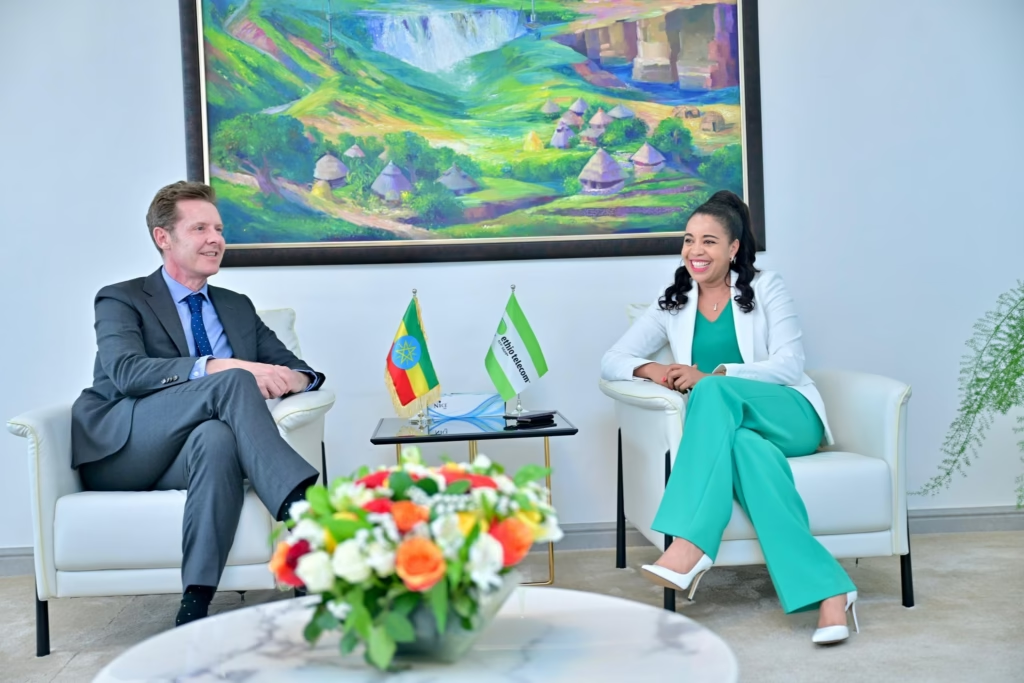
Mastercard alone expanded its Africa acceptance network by 45% in 2025. I recently saw them courting Ethio telecom in Addis Ababa. That sounds like progress but ask yourself: progress for whom? Every transaction fee flows back to New York, not to Nairobi, Addis Ababa or Lagos.
There is also the risk of being cut off from the system. Russia learned the hard way in 2022 after it started the war in Ukraine.
There is hope though. The Pan-African Payment and Settlement System (PAPSS) now connects over 115 commercial banks across Africa, allowing cross-border payments in local currencies. This is exactly the kind of system we need more of. As our elders say:
“If you always carry another man’s load, you will never know the weight of your own.”
2. They Sold Our Businesses for Peanuts
This one cuts deep. Especially for those of us from Uganda.
In the 1970s, President Milton Obote launched his “Move to the Left.” The government acquired 60% shares in all banks, insurance companies, and credit institutions. About 78 companies were nationalised. Idi Amin continued the nationalisation drive after him.
By the time President Museveni took power in 1986, Uganda had 146 state-owned enterprises.
Then came the Bretton Woods institutions — the IMF and World Bank — with their Structural Adjustment Programmes (SAPs). It was a major push in Uganda’s 90s and every economics class and conference talked about SAPs. I was a teenager in high school with deep interest in Economics. I remember attending one at Sheraton Hotel (formerly Apollo Hotel) where Professor Mondo Kagonyera presented a paper about SAPs.
The deal was simple: if you want our loans, sell your businesses. As CNBC Africa reported: “The Bretton Woods institutions further limited Africa’s state-led enterprises that had been established after achieving independence.”
Uganda sold all 146 parastatals. The World Bank expected to raise $500 million. They raised just $167 million. Why? Asset stripping. Undervaluation. Regime cronies buying public assets at giveaway prices.
Uganda Commercial Bank — the country’s largest bank with 67 branches, one on Kampala Road where we used to hang out as street kids (yes, we had a “depo” at UCB) — was sold to Stanbic Bank for just $19.5 million. Uganda Airlines needed just $500,000 to keep flying. It was denied and liquidated. Now they are trying to borrow to rejuvenate what they previously sold for peanuts. But the Airlines is making losses.
Then there was the UTC (Uganda Transport Company). When I ventured into Kampala in 1990 as a teenager, UTC still operated. As kids, we worked at the park in downtown Kampala making ends meet, but it was also sold.

Former Finance Minister Ezra Suruma said it plainly: they ended up “foreignalising the economy.”
This was not just Uganda. Across Africa, the SAPs forced countries to sell off state enterprises at knock-down prices. The result? Today, foreign companies dominate every sector of most African economies, while its children run overseas to find menial jobs!
3. Their Laws Were Never Written for Us
Here is something most people do not think about. The intellectual property and copyright laws that govern Africa were not designed for Africa.
The TRIPS Agreement, enforced by the World Trade Organisation since 1995, required every member country to adopt minimum IP standards. These standards were designed by and for developed nations.
As Sage Journals noted: “The migration to TRIPS was painful for developing countries as it required substantial revision of their IPR systems.”
Cross-border payments for the use of intellectual property exceeded $1 trillion in 2022, according to WIPO, with the United States of America toping the list of IP exports in 2022 (they received approximately $127 billion in IP payments).
And with 54 different countries, each with its own legal system, it is nearly impossible for any African nation to win a case against a multinational corporation. The legal playing field was never level.
I strongly believe Africa needs to decouple from these exploitative arrangements. They drain our resources instead of serving our development needs.
4. Our Data Sits in Their Capitals
This is where it gets truly frightening, and I have thought about this several times over the past few months.
The Africa Data Centres Association reported in 2026 that “the majority of data generated in Africa is stored outside the continent, mainly in Europe and North America.”
Africa accounts for just 0.6% of global data centre capacity. The entire continent — 54 countries, 1.5 billion people — has roughly 249 data centres. And 40% of those are concentrated in just three countries: South Africa, Nigeria, and Kenya.
What does this mean in practice? It means that when an African business stores its data, when an African government processes its citizens’ information, when you send a message or make a payment — that data travels to servers in London, Amsterdam, or Virginia. It sits under their laws. It is subject to their surveillance. It is accessible to their intelligence agencies.
This is the sole reason Russia banned several Western apps including Whatsapp and Telegram.
Meanwhile, Western and Asian corporations freely scrape African data — our browsing habits, our purchasing patterns, our social connections, our health records — and build billion-dollar businesses on it. They pay Africa nothing.
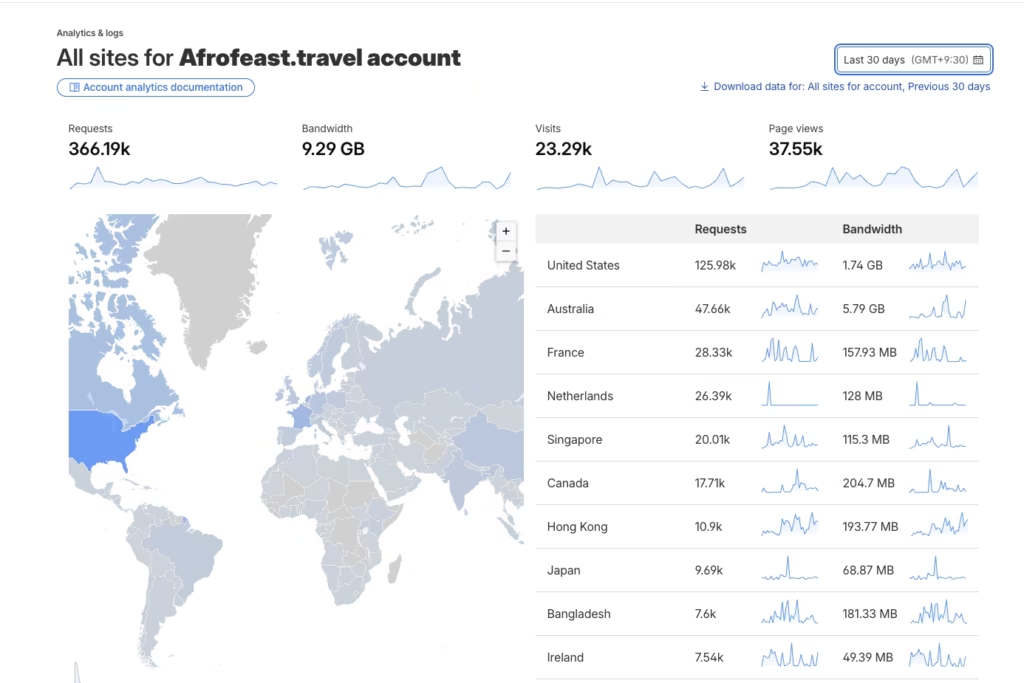
I recently asked Google why, despite not having clients in Hong Kong and Singapore, I get a lot of visits from those countries. Google told me those countries have Chinese and Western data centres and AI agencies and they could be sending bots on my sites to scrap data, as seen from our Cloudflare account below.
5. Our DNA Is in Their Hands
This is the one that keeps me up at night.
When Africans take genome tests through companies like 23andMe or AncestryDNA (I recently took one), that data is stored on servers in the United States and Western capitals, subject to their laws.
A 2025 article on genomic sovereignty in Africa stated clearly: “The outsourcing of African genomic data to laboratories and storage facilities abroad raises profound ethical, legal, and socio-political concerns.”
Even the H3Africa project, which stores some data at the University of Cape Town, eventually deposits genomic data at the European Genome-Phenome Archive.
As Pambazuka reported in January 2026: African countries are “surrendering their health sovereignty” by allowing foreign powers to control their biological data.
Think about what this means. Foreign governments and corporations have access to the genetic blueprint of African populations. They can use this data for drug development, bioweapons research, population studies, insurance profiling, or intelligence — and Africa has no say in any of it.
If you didnt know, the CIA has for over 60 years, kept detailed profile of all countries it called the World Factbook, only discontinued recently. Do you think they actually discontinued that project? I don’t think so. I think they have changed the format and now have access to data captured via the internet, AI and social media companies.
6. AI Is the New Scramble for Africa
Artificial intelligence is forecast to contribute $15.7 trillion to the global economy by 2030. The majority of that wealth will go to high-income nations.
Reset Global put it bluntly: “Most African nations pursuing ‘AI strategies’ are building dependencies, not sovereignty.”
The Data Pop Alliance called it “The Return of East India Companies” — where AI and data extraction from Africa mirror the colonial-era plunder of resources.
Here is how it works. Western and Asian corporations scrape African data for free. They use it to train AI models. Then they sell those AI products back to Africa and other countries as expensive services. Africa provides the raw material — our data — and gets charged for the finished product. Sound familiar? It is the same pattern as exporting raw cocoa and importing expensive chocolate.
ICTworks reported in 2025 that “African digital colonialism represents a new form of resource extraction” by Silicon Valley technology companies “with no equitable returns.”
7. Africa Is The New “Like Capital”
“Like capital” is my own invention. I didn’t read it anywhere. It is how I feel about these multibillion social media companies.
Here is something that does not get talked about enough.
Africa has 291 million Facebook users and 189 million TikTok users. WhatsApp penetration is 97% in Kenya, 96% in South Africa, and 95% in Nigeria. Africa’s population is heading towards 2.5 billion by 2050 — the world’s largest pool of young digital consumers.
Western platforms use all of this African engagement — every like, every share, every view, every follow — to inflate their global value, user numbers, attract advertisers, and drive up their stock prices. Africa provides the eyeballs. Silicon Valley takes the cut.
TikTok does not pay creators in most of Africa. Its Creator Fund operates in just 7 countries worldwide — and Nigeria, Africa’s largest creator market, is excluded. Facebook pays African creators as little as $0.01 for 1,300 views. That is INSANE!
They know we LOVE sports and like arguing about Arsenal and Manchester United so Facebook’s algorithm actively pushes European football — Premier League, La Liga, Champions League — to African users. The Premier League clubs alone have 820 million social media followers globally, with a huge share from Africa. Every African who likes, comments, and shares that content generates advertising revenue for Meta. Not for African football. Not for African creators. For Meta.
The Middle East and Africa digital advertising market generated $32 billion in 2024 and is growing at 16.7% annually. That money flows to Google, Meta, and TikTok — not to African platforms.
I will write more about this in a separate piece. Africa is the world’s “Like Capital” — and it is time we stopped giving away our engagement for free.
China Did It. Russia Is Doing It. Why Not Africa?
Some people will say: “But Singapore and Malaysia used Western systems and they succeeded.” True. But Singapore is a city-state of 6 million people with a strategic port and strong institutions. Africa is 54 countries, 1.5 billion people, and a completely different context.
Let me tell you what does hold. China.
I saw it with my own eyes in Shanghai, Nanjing, and Beijing. China built BeiDou, its own GPS system — now fully operational with 30 satellites and used over 1 trillion times. It built WeChat, Alipay, Baidu, Douyin, Weibo, Youku. Every single system — from navigation to payments to social media to search — is homegrown. Western Apps such as Uber have failed in China.
Russia, after being partially cut from SWIFT in 2022, built its own alternatives. The SPFS messaging system now connects 557 financial institutions in 20 countries. The MIR payment card replaced Visa and Mastercard domestically. Putin signed a decree phasing out all foreign IT solutions starting January 2025.
If China and Russia can do it, Africa — with the youngest population on earth (median age 19.5 years) and the fastest-growing digital market — certainly can.
Ethiopia Shows Us the Way
Not every African country followed the Bretton Woods playbook. Ethiopia kept its key corporations under government control.
Ethiopian Airlines remains 100% government-owned. In 2025, it generated $7.6 billion in revenue and carried 19 million passengers. It is Africa’s largest and most profitable airline.
Ethio Telecom generated $1.63 billion in revenue in 2023/24. While it has recently opened to limited competition, the government maintains control.
Compare that to Uganda, which sold its airline for nothing and its biggest bank for $19.5 million. Today, Uganda’s economy is dominated by foreign corporations. Ethiopia’s key sectors are still in Ethiopian hands.
Yes, government-run businesses can be inefficient in the short term. But in the long run, they build sovereignty. They keep wealth at home. They create jobs for citizens. They give governments the power to make independent decisions. China has succeeded this way by running businesses alongside private enterprises.
What Now? Opportunity Cost
Digital colonialism in Africa is not coming. It is already here. It has been here for decades, dressed up in the language of “development,” “free trade,” and “globalisation.”
But the tide is turning. PAPSS is live. African data centres are growing. Afrobeats is conquering the world. Africa’s population — the youngest, fastest-growing on earth — is our greatest asset.
The question is not whether Africa can build its own systems. China proved it can be done. Russia is proving it right now. The question is whether we have the courage to start.
There is a concept called opportunity cost in Economics. I think we need that to position Africa strategically.
Some might think I am just a West hater. I am not, and I don’t even care if you think so. I focus on what Africa needs to do to get out of modern colonialism. And through Afrofeast and OurRoots.Africa, I am committed to telling this story — our story — until every African knows the truth and demands better.
The time to build is now.
How I Landed in China with Zero Plans: The Power of Mental Recalibration