The Australia Social Media Ban: Why African Parents Should Be Worried
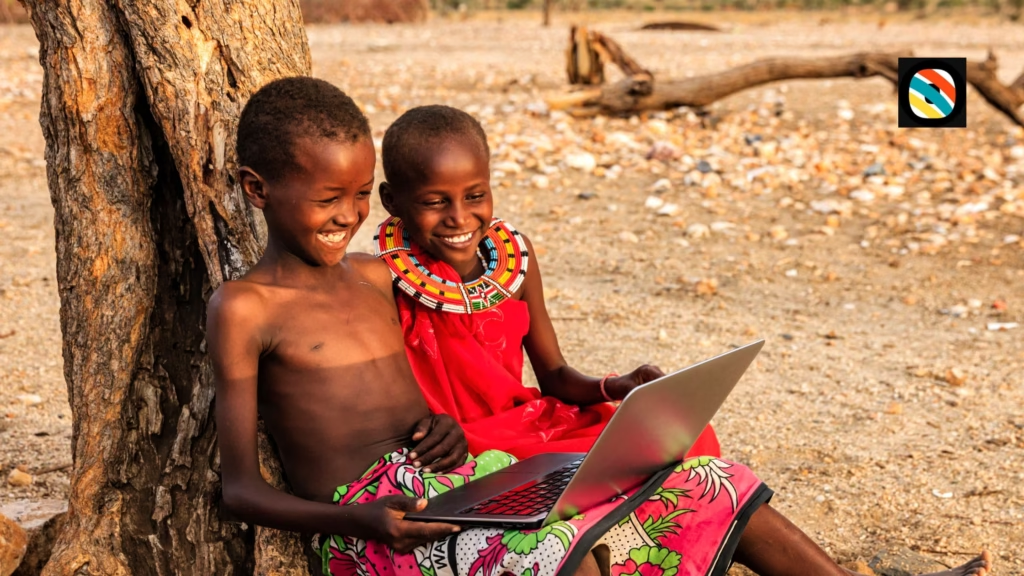
Let me tell you a story about a boy named Kofi.
Kofi lives in the suburbs of Western Sydney. He is 14 years old. If you saw him walking to school with his heavy backpack, you would think he is just a quiet, shy student. But Kofi has a secret life.
Every evening, after he finishes his homework, Kofi turns on a ring light in his bedroom. He sets up his phone and records videos teaching other kids how to fix computer bugs. He edits the videos himself. He adds music. He checks the data to see who is watching.
On the street, Kofi is just a kid. But online, he has 40,000 followers. He is a broadcaster, a video editor, and a young businessman. He is learning skills that his parents never even dreamed of.
Kofi is not a real name, however he represents thousands of Australian kids with social media accounts.
But recently, the Australian Government decided that Kofi should not have a tiktok account and instead focus on his schooling.
Under the new laws, children under 16 are banned from social media. The government says this is to save Kofi. They say they want him off his phone and “playing outside”. It sounds nice, doesn’t it?
The Australia Social Media Ban comes with a promise of safety, but what about the opportunities it takes away?
Many of us in the African community are looking at this differently. We don’t see safety. We see control. We see a system that is terrified of a generation it can no longer command.
In contrast, the Australia Social Media Ban may lead to a generation unprepared for the digital economy.
Australia Social Media Ban: Living in Two Different Worlds
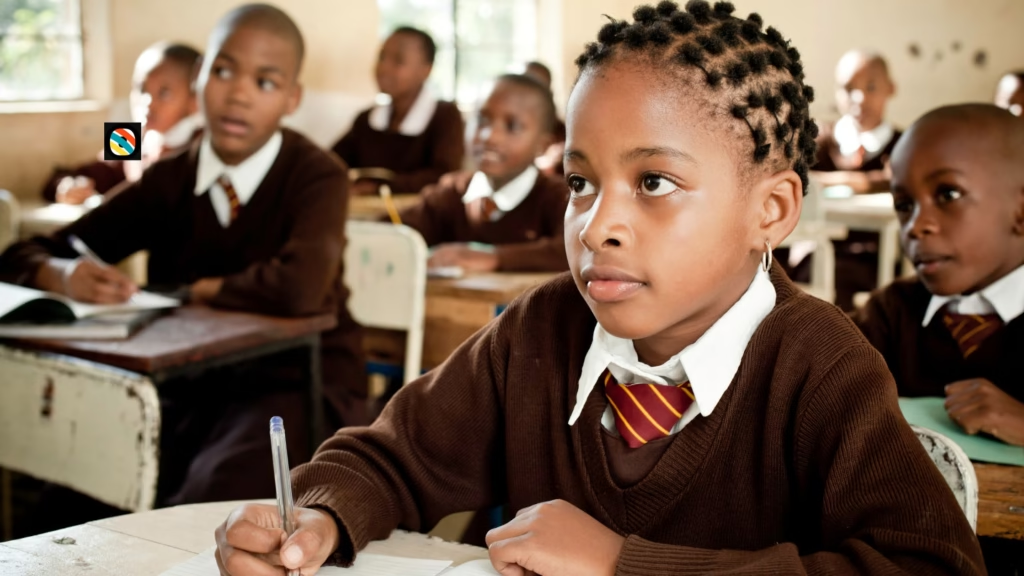
The problem is simple: the people making the laws are living in an analogue world, but our children are living in a digital one.
With the Australia Social Media Ban, children are missing out on learning to navigate a digital world.
The lawmakers in Canberra follow an old map. You know the one: Go to school > Go to university > Get a job > Be obedient.
Schools are designed to make children fit into a box. They teach you to stand in line, wear a uniform, and do what you are told. It is a factory model. But that business model is dead. The modern world rewards the loud, the creative, and the disruptors.
Look at Ryan Kaji. He is the boy behind “Ryan’s World” on YouTube. He started reviewing toys when he was just a pre-schooler. He didn’t wait for a degree. He built a business worth millions of dollars before he was even a teenager. Me and my babies used to watch him.
Or look at Charli D’Amelio. She started posting dance videos on TikTok at 15. She is now a global brand worth over $20 million.
Or, check out Ruri Ohama who started her youtube channel when she was 15.
These kids didn’t ask for permission. They just grabbed their phones and started creating.
By banning our children from these platforms, Australia is clipping their wings. It is telling them: “You are not allowed to be part of the modern economy. You must wait until we say you are ready.”
This Australia Social Media Ban sends a message that the youth should remain passive in a rapidly evolving economy.
The Real Fear: The Power of the Youth
If you dig a little deeper, you will find a second reason for this ban. It isn’t just about mental health. It is about criticism.
The Australia Social Media Ban is an attempt to stifle youthful voices that challenge established norms.
Young people today are the sharpest critics in the world. They can smell hypocrisy from a mile away. And unlike us, they don’t just complain at the dinner table—they organise.
We have seen this back home in Africa.
Remember Kenya in 2024? When the government tried to pass the Finance Bill to raise taxes, it wasn’t the opposition parties who stopped them. It was the children. It was Gen Z.
They didn’t use guns. They used TikTok. They used X (Twitter). They livestreamed the protests. They translated complex laws into simple videos so everyone could understand. They forced the President to withdraw the bill.
We saw the same thing in Bangladesh, where students used Facebook to organise a revolution that changed the whole government.
The Australia Social Media Ban is not just about safety, but about maintaining control over a generation.
The establishment in Australia watches the news too. They see this power, and it frightens them. By banning children from social media, they are cutting the communication lines. They are ensuring that for the first 16 years of their lives, children cannot criticise the government or organise effectively.
The fear of youth activism is at the heart of the Australia Social Media Ban.
After they turn 18, they will have jobs to apply and go to, so they will not be a threat to the establishment.
The “Coward’s Palace”
Australian politicians have a very thin skin. Over the years, many leaders here have called social media names like a “sewer” or a “coward’s palace.”
Why? Because on social media, you cannot control the narrative. If a politician lies, a 15-year-old can fact-check them instantly and the video will go viral.
Unlike in the US, where freedom of speech is protected, Australian politicians often sue people who criticise them. By removing the youth from these platforms, they are removing the loudest, most uncontrollable critics who cannot be sued.
The Trap for Migrant Families
For us African parents, this ban feels personal. We are trying to raise our children in a country that is very different from where we came from. Social media is often the only umbilical cord our kids have to their culture, especially after they have been removed and placed in foster care (read slavery).
This disconnection brought by the Australia Social Media Ban affects how migrant children connect with their heritage.
It is how they see the latest dance moves from Lagos r Jo’burg. It is how they hear their mother tongue spoken in Kampala. It is how they connect with cousins they have never met in Ethiopia.
The government here prefers a “uniculture”, although they preach “multiculturalism”. They want every child to learn about Ned Kelly, speak English only, eat pasta, and watch ABC, pretending nothing is wrong.
To migrant children, it is a way of saying: “Look, Australia is better than the poverty-stricken and violent countries and cultures you came from. Here everyone is equal.”
By cutting off the digital connection to the outside world, they are forcing our children to assimilate into the Anglo-Saxon culture. They are trapping them in a local bubble, but will abandon and deny them rights once they turn of age. In fact, many will be “othered”, locked up and deported.
Why We Are Looking Back Home
The implications of the Australia Social Media Ban are far-reaching, impacting cultural integration, which brings me to a difficult truth I discovered in law school.
If I look at the legal system here, I worry. Australia is the only Western democracy without a Bill of Rights, and it was intentional.
In the late 1800s, leading lawmakers deliberately designed the Constitution to exclude other races, including Aborigines. Most of those legislators served in the Australian Judiciary, either in Queensland or Canberra.
Since federation in 1901, the Constitution, which was designed to accommodate and serve only a chosen few, has only been changed 8 times out of 44 attempts, the last being in 1977 before many of today’s parents were born.
While in America, you have rights written in stone, here, rights are given and taken by government bureaucrats.
Today, they ban TikTok. Tomorrow, what else will they decide is “unsafe” for our children?
This is why you are seeing so many wise African parents making a hard choice. They are sending their children back home.
You see them in boarding schools in Nairobi, Accra, and Johannesburg. Personally, I know parents whose children live and study in Africa although they live here. It is the best decision for an African child.
We used to think we sent them back for discipline. But now, we are sending them back for freedom. We are sending them to places where they can learn to be resilient, street-smart, and globally connected, rather than being wrapped in cotton wool by a Nanny State.
The Commonwealth has now officially taken over the traditional role of a parent. The outcome? Mental health deterioration.
Conclusion
If you are a parent raising a child in this country, you need to be awake. This Australia social media ban under 16 is not just about safety. It is about keeping the status quo. It is about keeping young people obedient, quiet, and offline.
We need to make sure that even if the government closes the digital door, we find other ways to let our children fly. Because the future does not belong to the quiet ones. It belongs to the creators, despite the Australia Social Media Ban.
5 Mistakes African MEN Make When Moving Overseas | Bro, Learn From Pros