
6 Reasons Why Ethiopia Economy Future Will Top the Continent by 2050
I recently saw a headline that stopped me in my tracks: Ethiopian Airlines made 4.5 billion. My first instinct was to assume this was in Birr. I was wrong. After digging into the latest 2024/2025 financial reports, the reality is far more staggering: Ethiopian Airlines Group generated a record $7.6 billion USD in annual revenue.
This is not just a success story for a single company; it is the loudest signal yet that the Ethiopia economy future is on a trajectory to overtake the traditional giants of the continent—Nigeria, South Africa, and Egypt.
Some people might think I am biased because my friend Amen, the Afrofeast brand ambassador, comes from Ethiopia. Not really. As an African who has lived, traveled, and worked across several countries, I am well-conversant with African history, political economy and entrepreneurship.

Yes, true, Amen has asked me to return to Ethiopia to see the changes that have occurred since I last visited in 2023. She says they are massive and indeed I have viewed several postings on social media, however that did not influence my decision on this article.
@afrofeast Ethiopia Travel ✈️🧳2026 | Africa Travel 🌍#creatorsearchinsights #foryou #foryoupage #fyp #viral #trending #africa #2026 #afrofeast #ethiopian_tik_tok🇪🇹🇪🇹🇪🇹🇪🇹 #ethiopian_tik_tok #addisababa #afrofeasttravel #africantiktok #capcut #travel #city #trip #tourism #africantiktok
By the way, if you are not aware, I earned an ‘A’ in high school Economics and spent my first year at Makerere University (merit sponsored) immersed in micro and macro economics before focusing on Political Science and Sociology. I know how forces of demand and supply work, and I can easily write a potent essay on any subject in the field; I didn’t study in the age of AI (brag brag).
That background taught me one thing: numbers are important, but sovereign control and culture are what make those numbers sustainable.
Here are the 6 reasons why I am betting on Ethiopia to lead Africa by 2050.
1. The Sovereign Mastery of State-Owned Corporations
Western economists often preach that African governments must sell their “parastatals” to be successful. I’ve seen the long-term horror of this advice. Take Uganda, my country, for example. In 1995, the Uganda Commercial Bank (UCB) was sold to a South African entity (Stanbic). While Stanbic is a fine bank, the reality is that a vital pillar of Uganda’s financial infrastructure is now controlled by foreign interests. The profits are siphoned away, leaving the nation vulnerable.
Ethiopia has rejected this “sell-everything” trap engineered by World Bank economists and Western politicians. Just like China, the Ethiopia economy future is powered by a state that retains its “crown jewels.”
-
Ethiopian Airlines: Founded in 1945 and 100% state-owned, it is now the most profitable carrier in Africa, bringing in billions in hard currency. Whereas several African airlines including Nigeria Airlines are struggling, Ethiopian Airlines has been soaring and making big profits.
-
Telebirr: While others sold their airwaves to Western telcos, Ethiopia built its own digital ecosystem. As of early 2026, Telebirr has 58.6 million users and has processed a mind-blowing 6.88 trillion Birr ($40+ billion USD) in transactions.
-
Ethiopian Investment Holdings (EIH): This sovereign wealth fund manages over $150 billion in assets, ensuring the state reaps the rewards of its own growth.
2. The Power of an “Uncolonized” Identity
We were in a group tour in Quianmen Street in Beijing recently. I started chatting to a tour assistant who had recently returned from Ethiopia. I asked him why he specifically chose Ethiopia. His answer? “Because they were never colonized.”
This isn’t just a historical flex; it’s an economic brand. It creates a psychological sense of sovereign stability that attracts global partners on equal footing. When I saw Ethiopian Airlines direct flights at Pudong International Airport, I realized that Ethiopia is the primary bridge between the world’s manufacturing powerhouse and the African market. They aren’t asking for permission; they are building a gateway.
3. A 3,000-Year-Old Homegrown Civilization
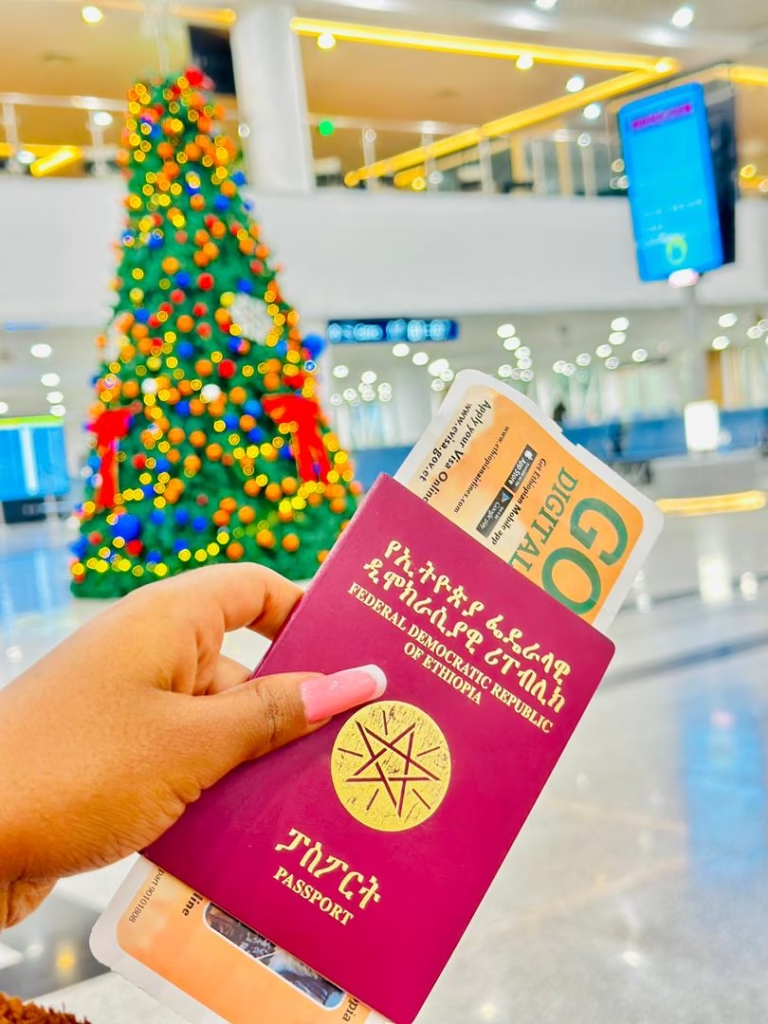
Ethiopia doesn’t “import” its culture or identity. Everything from their Ge’ez script (the only indigenous African writing system in wide use) to their unique calendar and religion is homegrown. In my studies of Sociology, I learned that relying on one’s own culture ensures faster social development and integration. Ethiopia has a civilisaiton that spans thousands of years, and that has helped it remain a dominant force in Africa.
4. A Market of 200 Million People
The scale of the market is massive. With over 139 million people in 2026, Ethiopia is already a demographic titan.
-
Population Projections: By 2050, the country is expected to hit 225 million people.
-
Internal Demand: This provides a massive internal consumer base, making the economy resilient to global shocks. With current GDP growth forecasts hitting 10.2% in 2026, the math for dominance is already working in their favor.
5. Strategic Gateway: The “Toll Booth” of Africa

Despite being landlocked, Ethiopia has turned the Horn of Africa into its personal logistics hub.
-
Strategic Location: It sits at the crossroads of Europe, the Middle East, and Asia.
-
The Transit Hub: Addis Ababa’s Bole International Airport has already overtaken Dubai as the leading transit hub for long-haul passengers into Sub-Saharan Africa. Ethiopia is building a $10 billion “Mega Airport” in Bishoftu to handle 100 million passengers. They are effectively becoming the “toll booth” for an entire continent’s travel and trade.
6. Zion: The Soft Power of the Diaspora
I’ve visited Shashemene and met Rastafarians from the Caribbean, Europe, and America living there permanently. To the global African Diaspora, Ethiopia is the “Promised Land.”
The reverence for Emperor Haile Selassie is a massive economic engine. This “cult-like” attachment translates into a permanent “brain gain” and a steady stream of “returnee” investment. Unlike other nations that struggle to connect with their diaspora, Ethiopia has a built-in spiritual and emotional bond with millions who view investing in the country as a sacred homecoming.
My take
The long-term impact of the Western “free market” model has often left African nations hollowed out and foreign-owned. Ethiopia is proving that an indigenous African civilization can build a modern empire on its own terms. With its $7.6 billion airline, its $150 billion sovereign fund, and its 200 million people, the Lion of Judah is ready to lead.